
Can an overturned urinal hold the same artistic value as Leonardo da Vinci’s masterpiece, the Mona Lisa? For art historians, this is by now an established fact, no longer worth debating. Among the general public, however, perplexity in the face of such a work arises naturally, and many still react with scepticism. The issue is that non-specialists make up the majority, and if it is true, as Joseph Beuys believed, that art represents hope and has a strong redemptive power for both life and society, then it would be preferable to encourage as many people as possible to engage with it.
Yet for many professionals in the field, art is—and should remain—a world reserved for a few select individuals, inaccessible to the wider public. Only in this way can they maintain their positions of privilege and surround themselves with an aura of mystery and absolute knowledge that others lack. This is why critical texts that attempt to explain the urinal speak of a “decontextualising semantic short circuit” simply to say that an object is presented in an unusual setting (quotation from A letto con Monnalisa).
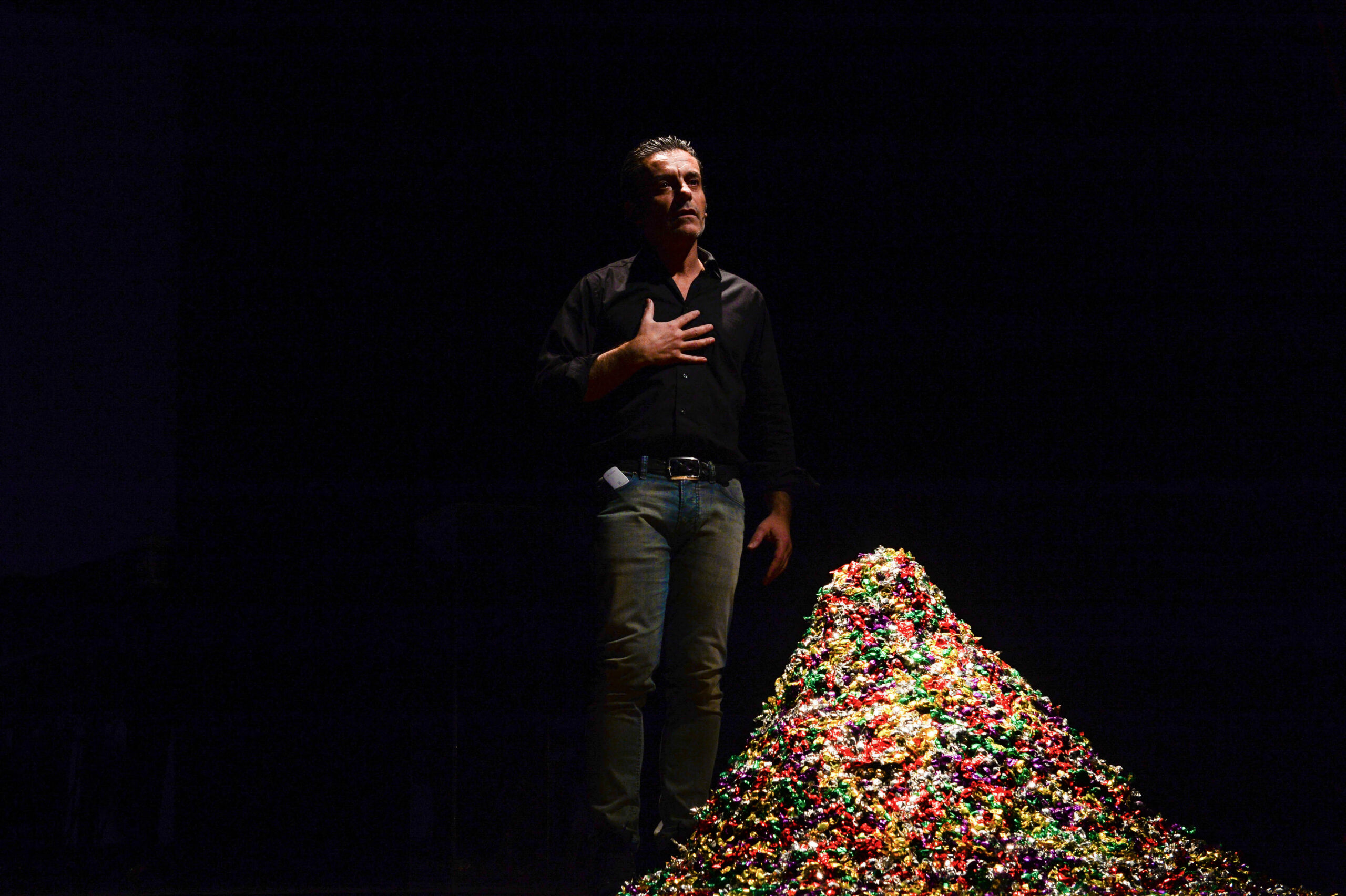
With the performance L’arte è una caramella (“Art Is a Candy”), Carlo Vanoni seeks to go against the current and do precisely what “experts” often do not: tell the history of art using a softened, accessible language capable of reaching everyone, especially those who love art but dislike contemporary art. He does so through music, stage elements, anecdotes, and irony. In this way, Leonardo’s Mona Lisa is compared to Andy Warhol’s Marilyn, Lucio Fontana’s cut is placed alongside Botticelli’s Primavera, and Marcel Duchamp’s famous urinal is set in dialogue with Caravaggio.
Directed by Gian Marco Montesano, a cultivated and versatile artist, L’arte è una caramella is a monologue that becomes a performance, aiming to demonstrate that art—from Giotto to Leonardo, through Manet, Van Gogh, and on to today’s artists—has always been, is, and will always remain contemporary.

