
Oltre Pinocchio
Cantico a Venturino
Descrizione
This exhibition pays tribute to Venturino Venturi, the artist who, more than any other, was able to translate the magic and complexity of the famous puppet
Descrizione
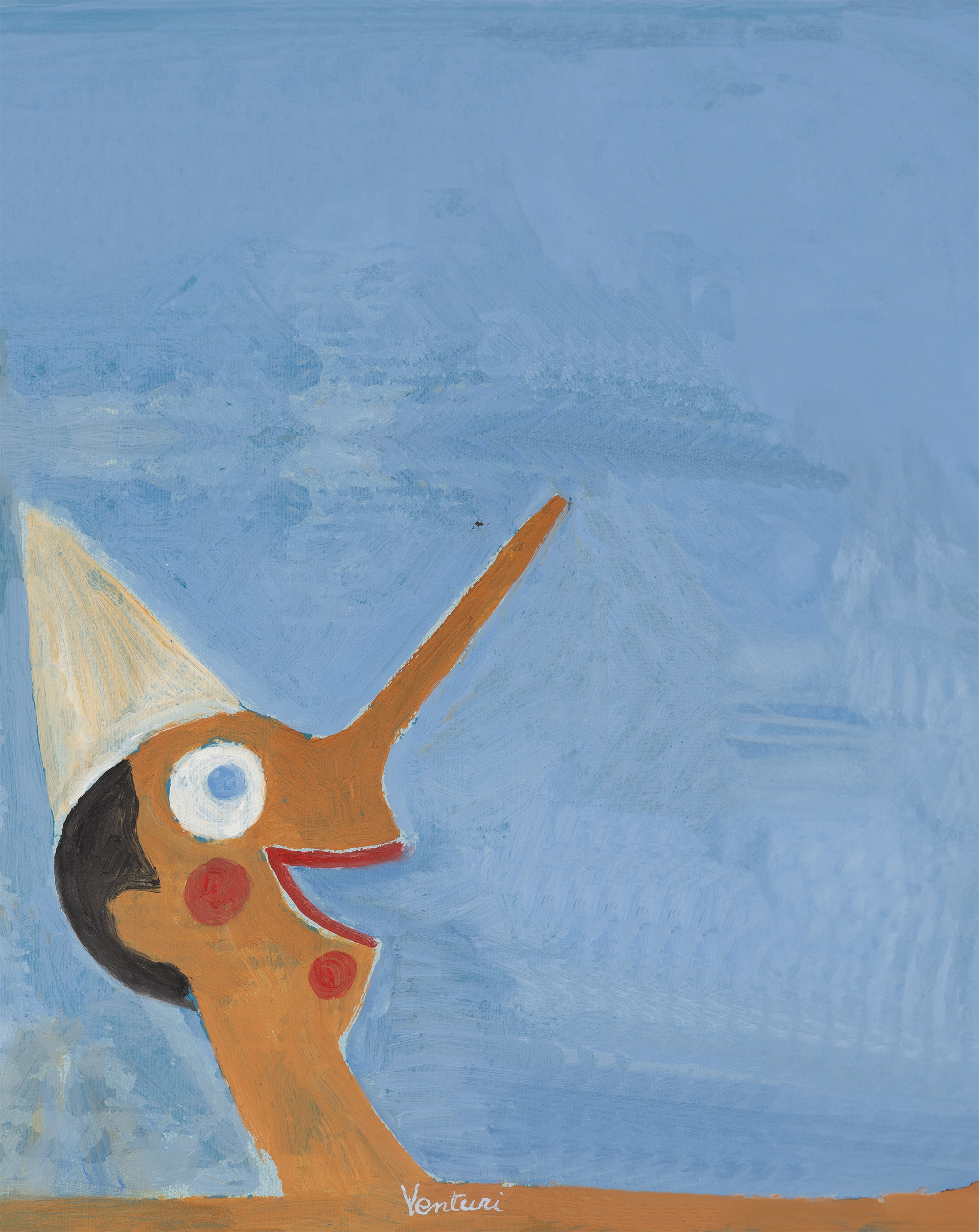
This exhibition pays tribute to Venturino Venturi, the artist who, more than any other, was able to translate the magic and complexity of the famous puppet into line and matter. Yet Oltre Pinocchio is not only a homage to Collodi’s character.
The exhibition explores the full scope of Venturino’s artistic research: from drawings to sculptures, from matrices to masks, from imprints to tempera paintings inspired by Pinocchio. It reveals a path in which the puppet’s story intertwines with a broader reflection on the human condition and on the language of art.
The exhibition presents a group of seventy-five works, drawn from the Archivio Venturino Venturi; the collection of Comune di Firenze – Musei Civici Fiorentini; Fondazione Nazionale Carlo Collodi; the BCC Banca Valdarno collection; and distinguished private collections.
Thirty original tempera paintings created by Venturino in 1986 for a special edition of Le avventure di Pinocchio, never shown to the public except at the presentation of the volume, portray an intense and dynamic Pinocchio, infused with the primordial energy that has always shaped the artist’s vision.
In Quattordici impronte a olio, executed between 1963 and 1968, matter becomes an essential trace, through a technique in which oil generates images of strong expressive impact.
A prominent place is given to six carved wooden matrices created as sources for monotypes, poised between geometric figuration and figurative suggestion, which so deeply fascinated Lucio Fontana and his circle. Used as matrices for only a brief period—all the sheets derived from them are dated 1948—they were later transformed into sculptures by Venturino himself.
Two sculptures dedicated to Pinocchio, both models for the large statue that was intended to stand at the center of the Mosaic Square in Parco di Collodi, are fundamental within the artist’s journey. The Pinocchio from the BCC Banca Valdarno collection is a casting whose original in cement is held by Musei Vaticani; while the sculpture in wood, iron, and nails, from Fondazione Nazionale Carlo Collodi, was presented by the sculptor for the competition to create the Monument to Pinocchio in 1953. It is an invaluable testament to the first conception of a Pinocchio that was never brought to completion.
A third sculpture, Ritratto dell’architetto Giovanni Michelucci, was created by Venturino during the important collaboration that linked him to the architect, an association that originated precisely from the Collodi project, for which Michelucci served as a juror and later also contributed to the design of the park.
Also on display are eighteen painted papier-mâché masks, through which the artist explored new expressive dimensions using three-dimensional form. Defined by essential lines and stylized shapes, they evoke, through face-portraits, the archetype of the puppet and its metamorphoses, embodying, in the tension between stillness and movement, the foundational modes of Venturino’s sculptural modelling.
Completing the exhibition is Turchino, an animated short film by Alice Rovai, which reinterprets Venturino’s world through a contemporary lens, creating a bridge between his poetic vision and today’s artistic sensibilities. Through movement and sound, the work conveys the vitality of Venturino’s line and material, projecting them into a new narrative dimension.
The exhibition is also accompanied by a video directed by Francesco Castellani, featuring interviews and materials from Archivio Venturino Venturi.
Venturino Venturi (Loro Ciuffenna, 1918–2002) was one of the most compelling figures in twentieth-century Italian art. Trained between France and Italy, he lived through crucial moments in history with an outlook always open to experimentation. His art, suspended between figuration and abstraction, captured the attention of critics and fellow artists; Lucio Fontana himself invited him to sign the Manifesto dello Spazialismo. Yet it is with Pinocchio that Venturino found one of his most powerful expressive keys.
This exhibition is therefore an homage to a master capable of transforming matter into poetry, and to a figure, Pinocchio, who continues to speak to us of growth, metamorphosis, and hope. It offers an opportunity to discover, or rediscover, an artist who made inquiry and emotion the core of his work.
The catalogue, edited by Marta Convalle, Lucia Fiaschi and Filippo Bacci di Capaci, will be published by Edizioni Fondazione POMA Liberatutti as part of the PomArte series.

